Work/Square/Managerbot
Case study · 2025–2026 · Square

Designing the experience paradigm for Square's first proactive AI agent

I defined what human-AI interaction looks like across the platform, and shipped Managerbot — the most advanced small business AI agent on the market.

RoleHead of Content + Conversation Design
Timeline9 months
ProductManagerbot
OutcomeShipped Apr 2026
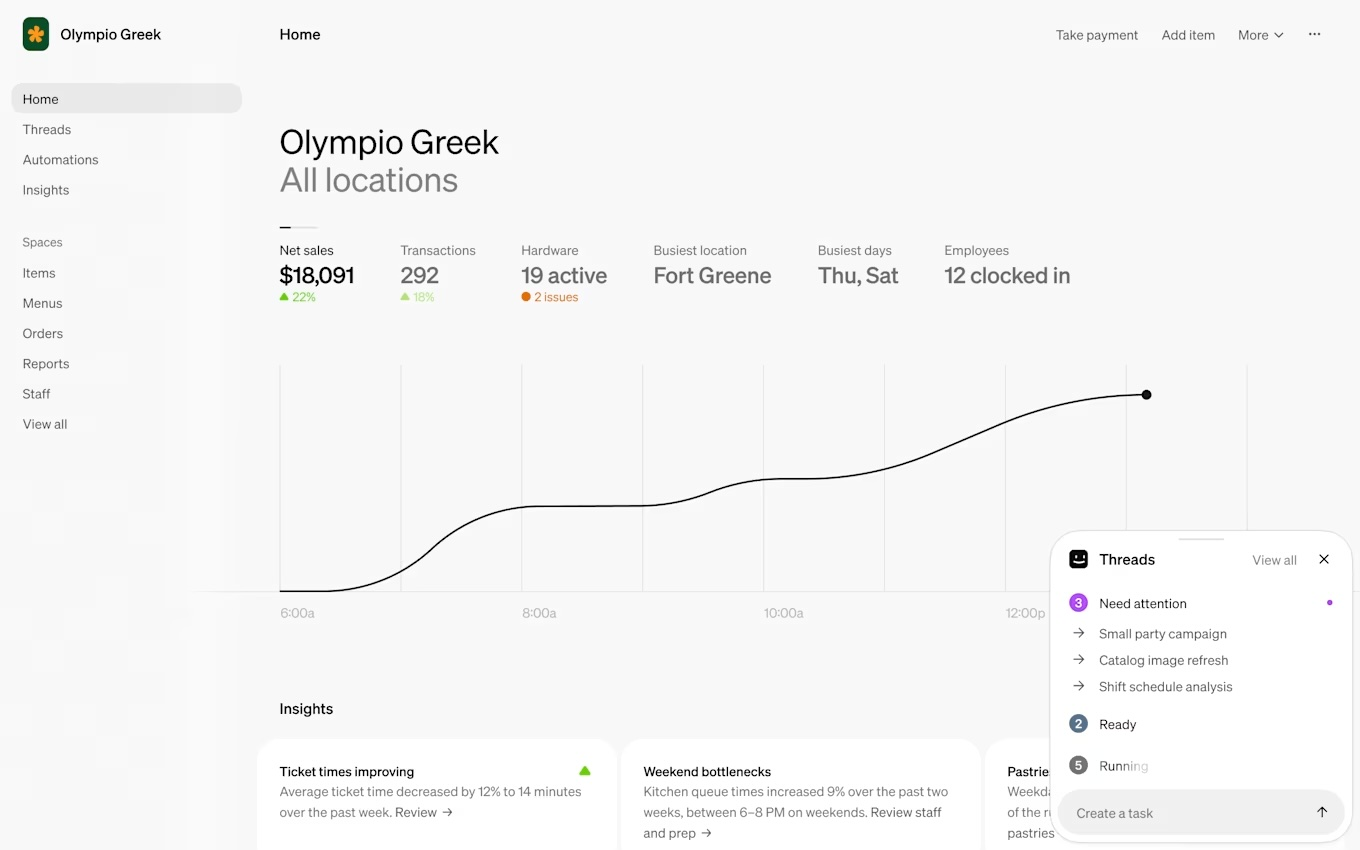
Managerbot dashboard showing Olympio Greek business insights, threads, and tasks
01 / The shift

From reactive chatbot to proactive agent

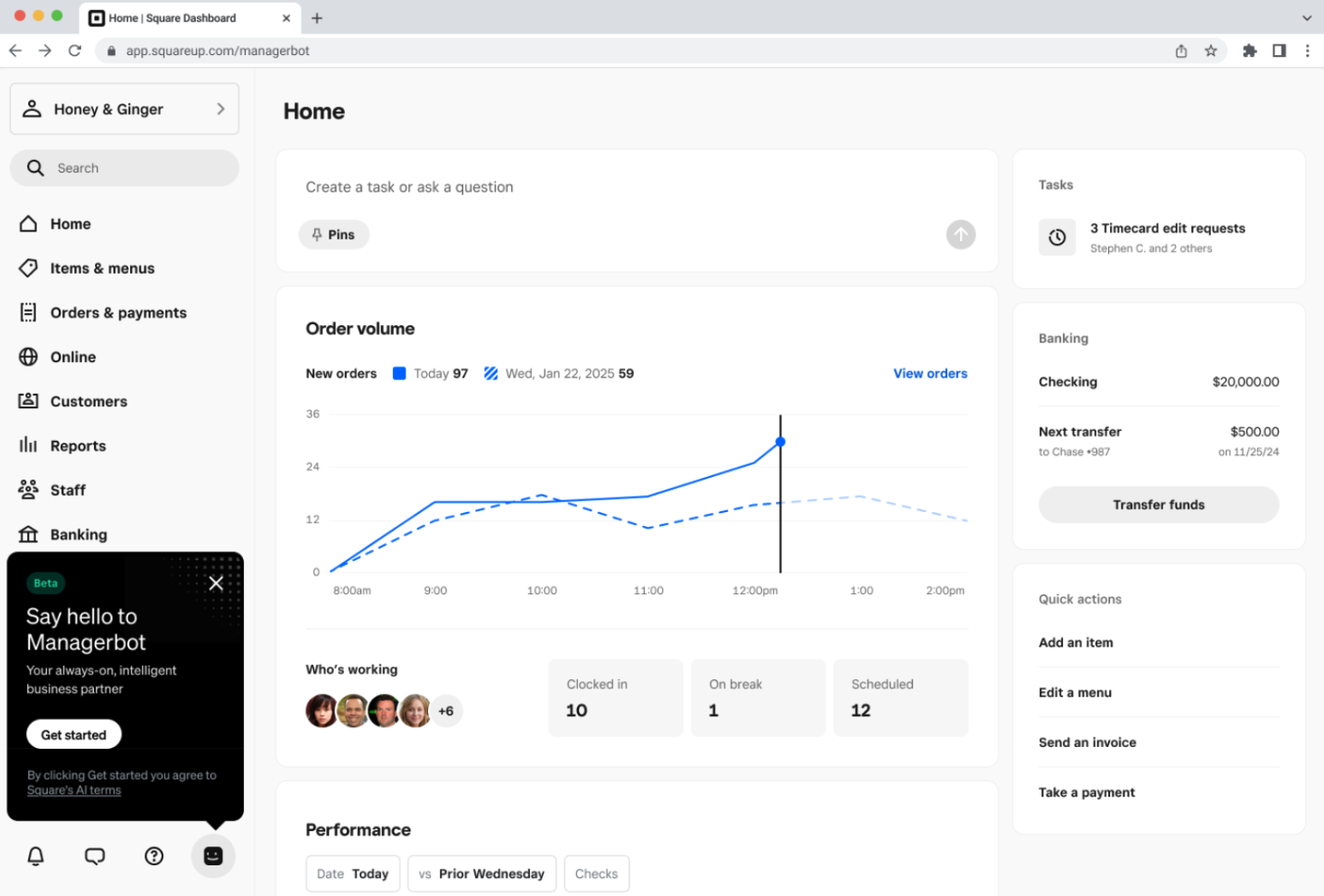
When I joined Square, the AI product was Square AI — a reactive assistant embedded in the dashboard that could answer sellers' questions about their sales, employees, and business performance. Ask it something, get an answer. Useful, but limited to what you already knew to ask.

Where it started — Square AI, the reactive conversational assistant

Square had been collecting tons of data on behalf of sellers for years — inventory, sales trends, labor costs, customer return rates. The problem wasn't that the data didn't exist. The problem was that finding it required sellers to already know exactly what they were looking for. They were digging through reports, manually running reconciliations, toggling between tabs. Even with dashboards, the burden still fell on the operator: which report to pull, which time frame to select, which variable to isolate. For small business owners juggling the kitchen, the staff, the floor, and the books, that's time they don't have.

Early prototypes leaned into a chat-forward "ask me anything" interface. But when sellers saw it, the feedback was clear: they didn't want to have to ask. They wanted to be led. They wanted to know what their attention needed to be on that day and what was trending in the wrong direction. And most importantly, they wanted the system to surface that info to them.

That insight was the beginning of moving away from dashboards entirely. The product evolved into Managerbot: an AI agent that watches your business on your behalf, monitoring inventory, forecasting demand, generating shift schedules, drafting marketing campaigns, and surfacing what you need to know before you know you need it. It doesn't wait for a question. It finds the problem and proposes the solution.

That's the shift from tool to agent. And designing it required building something that didn't exist yet: a framework for what trustworthy, proactive AI looks and sounds like in a high-stakes commercial environment.

Under the hood, Managerbot runs on third-party frontier models, including Anthropic's Sonnet and OpenAI's GPT family, but the competitive moat is the agent harness Block built around them, drawing on Goose (Block's open-source agent framework) and learnings from Cash App's consumer-facing Moneybot. The challenge specific to Square is scale: a single seller might interact with hundreds of different tools across invoicing, inventory, customer management, marketing, payroll, and scheduling — all of which Managerbot must navigate coherently within a single agentic loop.
02 / My role

Defining how a COO should sound and operate

I owned the experience paradigm for how sellers interact with AI across Square: the voice, the interaction model, the documentation standards, and the design system for human-AI surfaces. Managerbot was the first and most significant expression of that work.

03 / The challenge

How do you act on someone's behalf — and earn their trust while doing it?

Small business owners are already strapped for time. The last thing they need is an AI that adds noise, surfaces irrelevant alerts, or takes an action they didn't understand or approve.

The design challenge wasn't just visual. It was philosophical: what does it mean to be proactive without being presumptuous? What does it mean to take initiative without taking control? And how do you communicate what an AI is about to do — in a way that a florist in Ohio or a restaurant owner in Austin can understand and trust — before it does it?

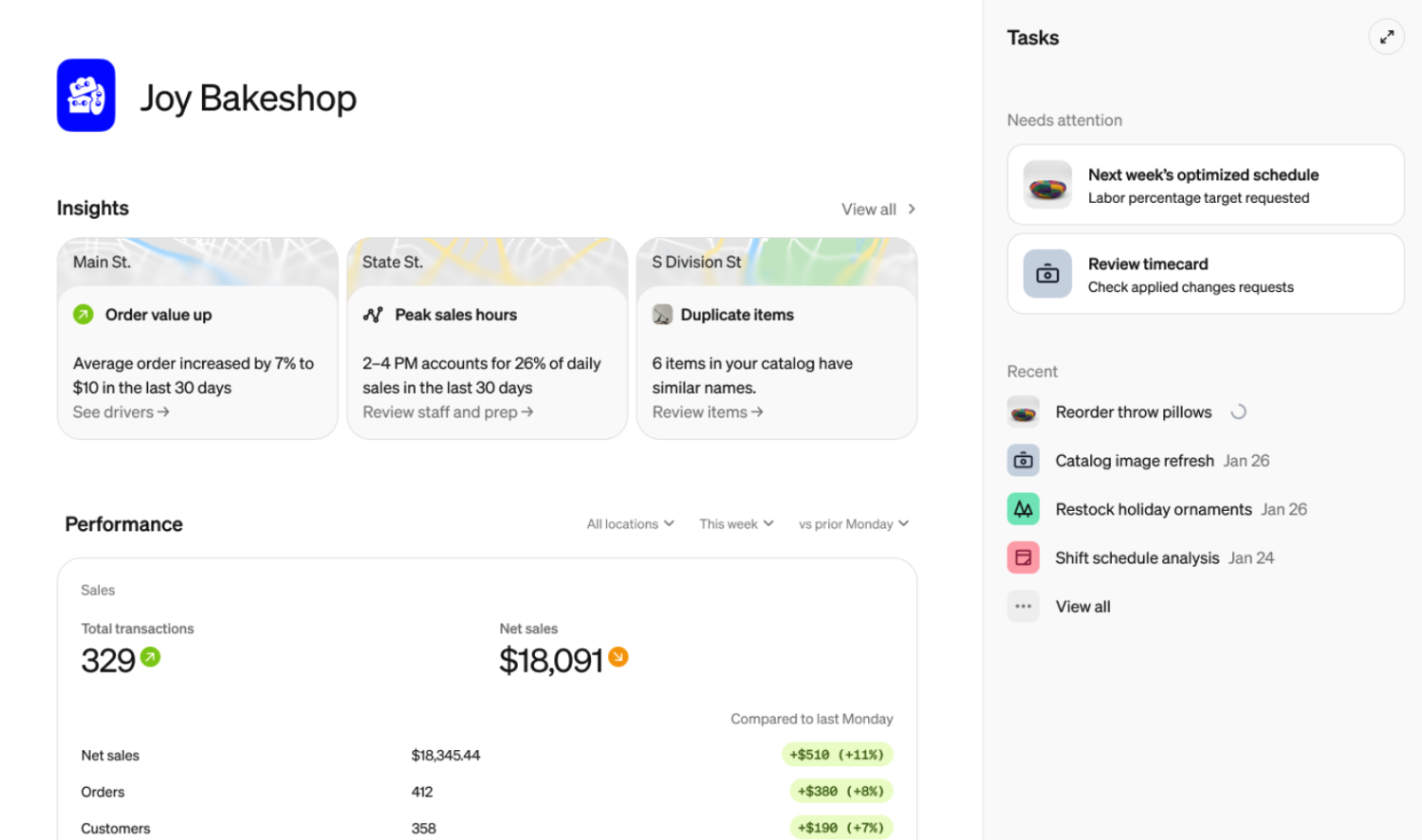
Managerbot insights dashboard

Managerbot insights — surfacing what matters before you ask

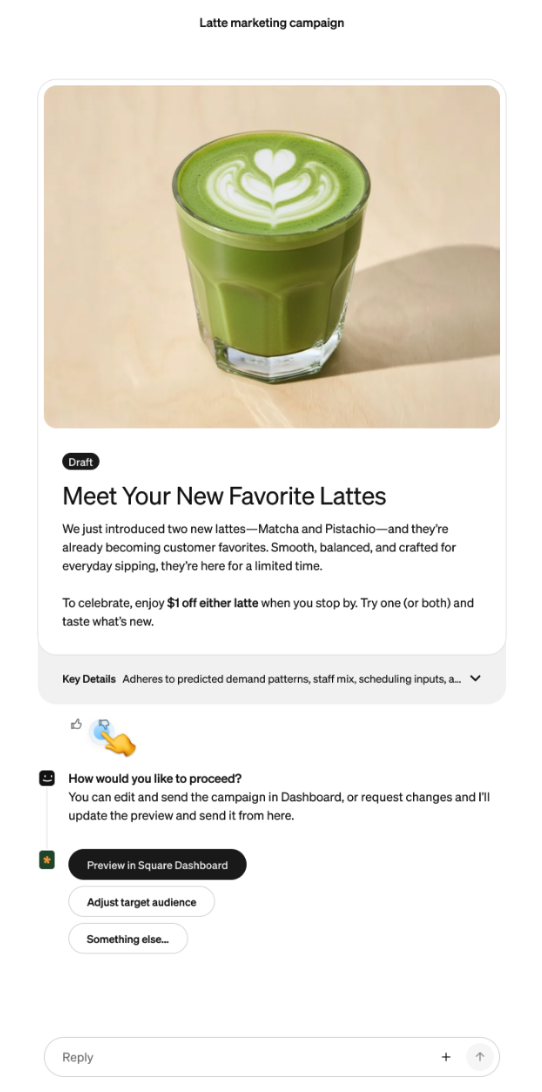
Managerbot task feedback

Task feedback — sellers review and approve every action

04 / The hardest call

The human-in-the-loop approval model

Every action Managerbot takes requires explicit seller approval with a visual preview of exactly what will change. This wasn't just a product decision — it was a design value.

We built the experience around the premise that trust has to be earned interaction by interaction, and that the right design constraint is: don't do anything the seller doesn't understand.

That's not the fastest way to build. But it's the right way to build when you're touching someone's livelihood.

05 / What shipped

An agent that runs your business with you

Managerbot launched in open beta on April 28, 2026 inside Square Dashboard — available to most non-franchise food & beverage, retail, and health & beauty US sellers at no additional cost. It's accessible to account owners and employees with full access permissions.

The product works on one key principle: Managerbot proposes, the seller decides. Every action requires the seller's explicit approval before it executes — keeping owners in control while giving them time back. Early data shows restaurant operators, who face some of the most complex daily operational demands of any business type, are among the most active users.

Managerbot full dashboard with insights and tasks

The full Managerbot experience — insights on the left, tasks on the right

Sales & labor monitoring — daily performance breakdowns by location covering sales, labor percentage, and trends, surfaced automatically without requiring sellers to pull a single report.

Inventory management — tracks sales velocity against stock levels and flags potential shortages before they affect service. Sellers can update item availability across all locations through a single voice or text command.

Staff scheduling — drafts optimized schedules based on projected sales volume, team availability, and the seller's own staffing requirements. Every draft is presented for review and approval before anything is published.

Marketing campaigns — identifies sales patterns and customer behavior to surface targeted campaign opportunities, drafting content for the seller to review, edit, and approve before it goes out.

Proactive catalog management — flags catalog issues before they affect the customer experience: items without photos, duplicate tax rates, missing descriptions, all without being asked.

Reversible by design — sellers can undo any action Managerbot takes by simply asking it to reverse the change.

At the center of all of this is Pulse — Managerbot's proactive insights engine, designed to function like a high-achieving business manager who shows up every morning with a plan. Pulse was built by studying years of seller behavior across Square: the custom reports people generated, the data they checked most often, and the questions they didn't yet know to ask. Rather than waiting for sellers to find the right report, Pulse surfaces what matters first.

A concrete example: a seller might assume they're losing money by keeping staff on for an extra hour at closing. Managerbot runs the actual labor-to-revenue numbers and shows them the opposite is true — the revenue from that extra hour outweighs the labor cost. A decision that felt like a gut call suddenly becomes data-backed. We had a thesis around "audited automation" — the idea that automation people can inspect and verify is automation people will actually use.

06 / Seller voices

Built with sellers, not just for them

The feedback that shaped Managerbot came from the lived experiences of sellers handling dinner rushes, busy retail floors, and last-minute staffing shortages — not from a testing environment. Square invited sellers to use Managerbot in real operations and share what works, what needs improvement, and what's missing, with feedback flowing through the Square Seller Community and through the product itself.

What's making me go 'wow' is the proactivity. It flags inventory risks before we run out, catches catalog issues before a customer sees them, and can even show me the schedule conflicts that could cause me a headache. — Donnie McClanahan, multi-location café operator · Knoxville, TN
It's not replacing my judgment; it's giving me the information I need to make better decisions faster. — Ryan Prellwitz, Vines & Rushes Winery · Ripon, WI

The goal is to give every small business owner the kind of operational intelligence that used to require an entire back-office team — while keeping the seller in the decision seat.

07 / Real talk

Designing a proactive AI for small businesses is not a neutral act

Every design decision about what Managerbot should say and how it should say it was one of the most important design decisions we made. An incorrect inventory recommendation costs a seller money. A misleading shift schedule disrupts someone's employees. A poorly framed lending nudge in a regulated context can cross a line and quickly lose trust.

When you're designing AI for trust, every word in the interface is load-bearing. There's no filler copy in an agent experience. Every label, every confirmation, every explanation the agent gives for why it's recommending something — that's the product. The delicate balance between trust and transparency is really essential in this dynamic.

08 / What I learned

Proactive AI is a design problem before it's an engineering problem

The hardest questions weren't "can the model do this?," they were "should the agent say this now, in this way, to this person?" Answering those required building new design standards from scratch: for agent voice, for human-AI interaction patterns, for what approval flows look like when the stakes are financial.

We asked sellers what they'd do if Managerbot gave them three to five hours back every week. The answer was almost universal: they'd grow. Open a second location. Launch a new product line. Finally get to the marketing they never have time for. Most sellers started their businesses because they love the work and care about their customers — the operational overhead is just part of the job. The product is being designed to absorb as much of that load as possible.

When you're designing AI-native agents, the interface isn't a screen. It's a relationship.
Press
Next case study
TikTok Shop
↑ Back to all work
Amanda Lasnik · amandalasnik.com © 2026